
Understand What Antrim County Deed Records Convey
Deeds share the ledger with a good deal more. The Antrim County Register of Deeds records mortgages, assignments, discharges, patents, leases, liens, probate orders, land contracts, surveys, plats, and government corners too. Each instrument type tells you why a filing exists. The text and legal description then show which interest it touches.
| Deed Type | What It Does | Common Use |
|---|---|---|
| Warranty deed | Conveys an interest with stated title covenants | Conventional transfer |
| Quitclaim deed | Conveys whatever interest the grantor holds without warranty | Release or corrective transfer |
| Administrator deed | Documents a transfer made under estate authority | Estate conveyance |
| Sheriff deed | Records a transfer arising from a statutory sale | Foreclosure proceeding |
| Tax deed | Records a delinquent-tax process transfer | Tax-foreclosed parcel |
A deed transfers an interest. A mortgage or lien burdens it. Read the attached releases, assignments, easements, exceptions, and prior references before drawing any conclusion, because the label on a deed is never the whole title story.
Cross the Antrim County 1990 Online Cutover
Real-property records in the county reach back to 1856. Online access is younger. AVA, Laredo, and Tapestry generally cover 1990 forward, while the older statutory name indexes and recorded books stay at the Register's office. A chain starting in 1989 splits at that line: pull later instruments from the web products, then plan a courthouse visit for the earlier deed-book run.
| Record period | Primary route | Practical limit |
|---|---|---|
| Latest filings | Laredo or office | Free AVA omits about 30 days |
| About 1990 forward | AVA, Laredo, Tapestry | Images and access costs vary |
| 1856 to pre-online years | Office index and books | Appointment and manual references |
The county also notes book-form indexing stretching back before the early 1990s. Treat 1990 as the practical web boundary. Not every older citation carries a digital image.
Narrow the Antrim AVA Deed Search
The free AVA index lets you search by party, date, instrument type, address, subdivision, parcel, municipality, or tract. Broad name sweeps can pull in strangers who share a surname. Add a date range or land key whenever you can.
| Search field | Accepted clue | Research use |
|---|---|---|
| Last/Business and First Name | Optional text | Find recorded party variants |
| Date range | MM/DD/YYYY | Bound an expected transfer |
| Document number/type | Exact or autocomplete | Retrieve or classify an instrument |
| Book/page/reference | Text | Follow a citation from another deed |
| Subdivision, lot, block | Recorded plat caption and numbers | Locate a platted village parcel |
| Parcel/municipality | APN or jurisdiction | Cross-reference assessment records |
| Section/township/range | Tract criteria | Locate rural land |
The captured AVA landing screen documents the modern Antrim deed-record entry point.
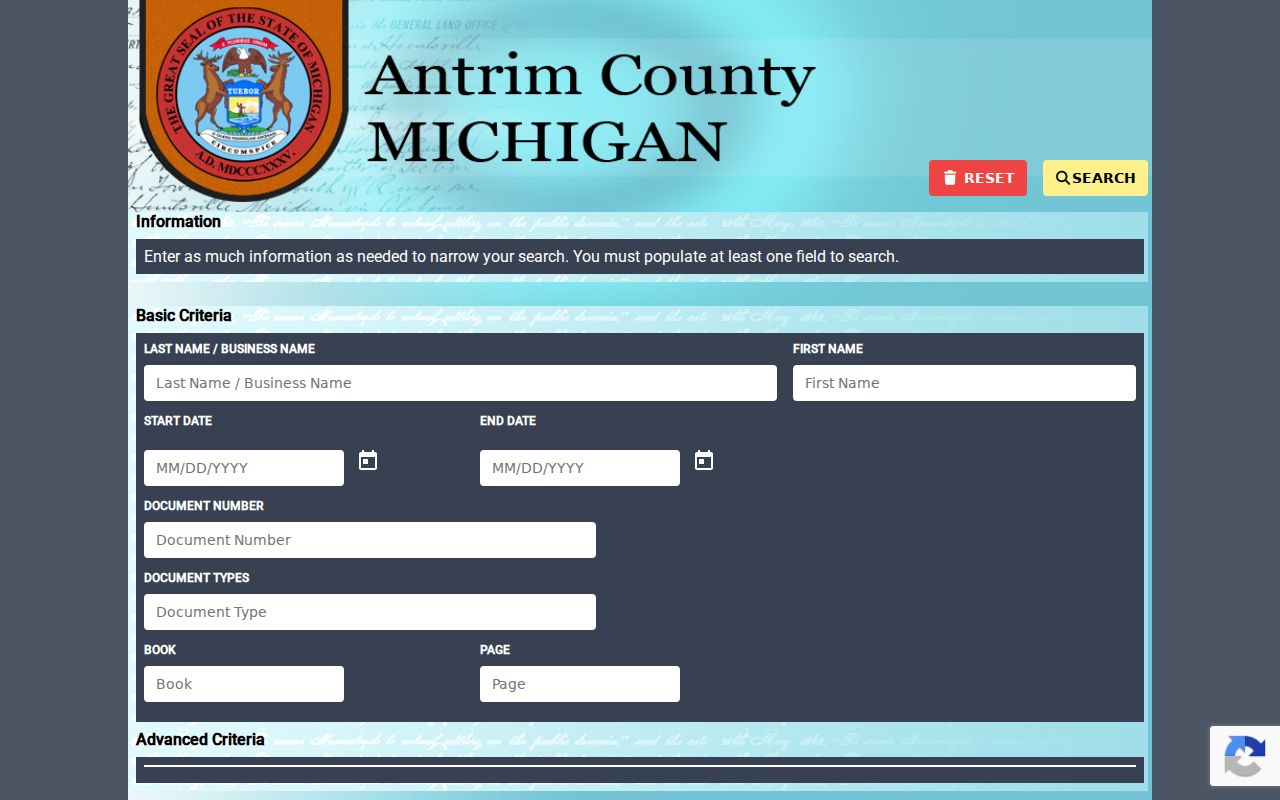
It is only an index. Match every hit against the deed's land description before trusting it.
Walk the Antrim County Grantor-Grantee Index
Start from a deed tied to the right land. Record both parties and the reference. Then step through the chain one transfer at a time, which is safer than forcing a modern street address across the county's whole recorded history.
- Find the current owner's acquisition deed and verify the legal description.
- Copy the grantor, grantee, deed type, recording date, and instrument or book/page reference.
- Search the grantor as an earlier grantee, then open that acquisition deed.
- Repeat through name variants and estate or entity transfers; continue in office books before the online cutoff.
- Grantor
- The party conveying or releasing the recorded interest.
- Grantee
- The party receiving the interest described in the instrument.
- Chain of title
- The sequence of instruments linking interests in the same land.
- Book/Page vs Instrument #
- Two retrieval references; preserve the form printed in the Antrim index.
Check the Details Behind an Antrim Index Hit
A result in AVA can carry a lot of detail. It lists document number and type, recorded and document dates, Party1 and Party2, reference number, subdivision, parcel, legal description, consideration, associated documents, recording fees, return information, page count, and image controls. Coverage varies by instrument. The index is the entry point; the recorded deed is the record.
Check the legal description, not just the street. Match it against the current parcel number, the plat, and the prior deed. Open continuation pages. Read associated releases and corrective instruments too. The Antrim County property search supplies the parcel and owner keys. This page follows the instrument trail itself.
Obtain an Antrim County Deed Copy or Certification
Start on the Register's access page. It lays out four ways in: free AVA, subscription Laredo, and pay-as-you-go Tapestry. Appointments at an office terminal are the fourth option. AVA prints images at $1 per page, with a $30 card hold at the outset. Tapestry runs $8.75 per search plus $1 per image page. Laredo subscription access is described as current within 24 hours. Images also cost $1 per page.
The county fee schedule fills in the rest. Recorded-copy pages run $1, and plats cost $2 per page. Certification of a recorded copy is $5 for the first page. For in-person service, go to 203 E Cayuga Street, Room 140, Bellaire. You can also call 231-533-6683 or mail PO Box 376. Staff open the public index by appointment. Title searches, though, are left to you.
Recorded, not guaranteed. Antrim County deed records give notice of filed instruments, but the index is not a legal opinion, boundary survey, or guarantee of marketable title.
Keep Antrim Recording Charges Separate From Copy Fees
Recording a new real-estate document costs a flat $30 county fee, effective October 1, 2016, plus $3 for each additional instrument assigned or discharged. Certification or tax certification adds $5. Warranty deeds, land contracts, and assignments or amendments touching a legal description require a $5 tax certificate under MCL 211.135.
E-recording runs through Simplifile or EPN. USPS and commercial delivery both work, and the drop box at the southeast building is checked periodically. Confirm current document requirements before you submit. Electronic delivery cannot fix a deficient instrument.
Watch New Antrim Filings With Property Fraud Alert
The Register links to Property Fraud Alert, a free name-monitoring service that sends notice when a potentially matching instrument enters the index. Think of it as an early warning, not a recording block. It is not proof that a filing is fraudulent.
The enrollment page walks you through county selection and contact setup.
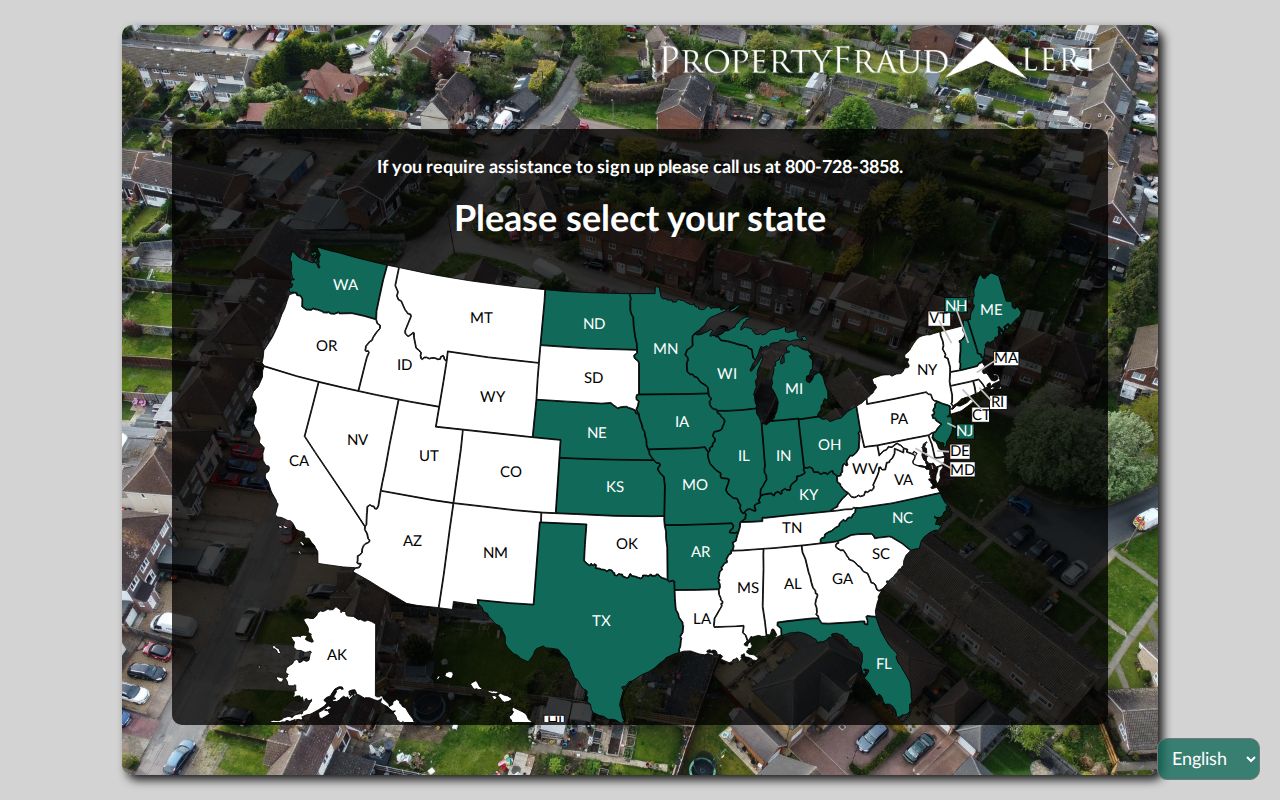
Register every likely spelling of your name. Compare any alert with the actual deed record, since a match may belong to someone else entirely.
Continue Antrim Deed Research Through the 1856 Books
Older deeds, patents, land contracts, and tax deeds generally live in the Register of Deeds name indexes and bound volumes. So do boundary agreements and easements. Government corners, surveys, and plats live there too. Names carry the search. When names alone fall short, bring section-town-range details or a recorded subdivision with its lot and block. Preservation here is tangible. The Register scans and microfilms every document. A duplicate microfilm set sits in underground storage.
The Library of Michigan Antrim guide lists 1897 and 1910 atlases, a 1930 plat book, a 1941 map, and community newspaper runs. Those sources help reconcile old roads, owners, and published notices. They never replace recording. The Archives of Michigan also holds selected assessment rolls from 1929 to 1941. It holds a rural-property inventory covering 1936 to 1942. Call the staff before visiting, since some material may be stored off-site.
An old atlas can hand you a township. It can also give a village block, a landowner spelling, or a road name that unlocks the office index. Newspaper microfilm can date a sheriff sale, estate notice, tax notice, or construction story. Turn each clue into a targeted grantor, grantee, tract, or date query. Then go back to the recorded book. The county seat moved to Bellaire in 1883. That shift matters for custody questions. It proves nothing about survival, though. The Register and the Archives guides remain the authorities on what each institution actually holds.
Note: Antrim County records no destructive courthouse fire, so do not infer either loss or complete survival from silence.